Tuesday, December 31, 2024

Political, Economic, Liberty, Tyranny

 From the point of view of the person on the street, does the “ideological” framework of an authoritarian government really matter?  Is the person walking gingerly through the streets of Soviet Moscow any more or less oppressed than the person trembling their way through the avenues of Nazi Berlin?

I suspect that the real problem with both Soviet and Nazi systems is only marginally about the ideology and centrally about the assertion of power by the führer or tsar or caudillo or absolute monarch.


I understand that some ideologies require that there be a führer.  Fascism depends explicitly on the centralization of power in the hands of a single “leader.”  So too the absolute monarch, so that as far as I can tell being under the authority of Benito Mussolini is as terrorizing as being under the authority of Henry VIII.  In economic terms the phenomenon translates into establishing a command economy, whether the economy is ideologically of the left or of the right.


In that context, I’d argue that the “zi” part of Nazis, derived from the official name of the party, National Socialism, is wrong.  There’s not a hint of “socialism” in a command economy such as Hitler created.  It should rather be called Nacomm, since Soviet communism was as much a command economy as was Nazi “socialism.”  And of course the political direction of any command economy is ultimately towards authoritarianism.  That reality defines the transformation of the Marxist notion of a workers’ paradise into the actual economic model practiced in communist countries, which is perhaps more properly called state capitalism than communism.  But then fascism is also state capitalism.  The difference between the two forms of state capitalism is the fiction, otherwise called the ideology, that says that the source of authority in the state capitalist economy comes from public ownership (“communism”) or from private ownership (“fascism”).


Socialism, real socialism, and capitalism share the idea that an economy should be determined by demand, not command.  The two ideologies differ about who should control the means of production.  Capitalism requires that such control should be private, and socialism that it be public.  Both private (capitalist) and public (socialist) ownership respond to what the people want, what they demand, as the people choose one product over another.


Capitalism and socialism can both make large scale infrastructure such as major highways publicly owned, although there are cases where capitalism allows roads to be privately owned.  In fact, for capitalism public ownership of infrastructure is often very limited—energy production is privately owned, for instance—whereas for socialism public ownership extends to a greater number of essentials—not just energy production but also the provision of health services, for instance.  For both capitalism and socialism, consumer enterprises such as mom and pop stores or even large industries like auto production remain in private hands.


In capitalism the profit derived from an adept response to demand is also private, creating the wealth of the rich.  In socialism profit is invested in the public interest—in infrastructure, services, benefits made possible by that profit.  No one, or very few people are rich, but the community as a whole becomes richer by publicly owned infrastructure and services.


With enough intervention on the political side of things, however, both capitalism and socialism can end up in the dictatorial modes of communism and fascism.


For capitalism, the pull toward command appears when the wealth of private enterprise comes to dominate the power of government.  The domination of American politics by the richest one percent of the population is a case in point.  Given enough domination of politics, the system becomes an oligarchy, and turns decisively to a command economy when government is not just controlled but effectively owned by the wealthy.  As a result the oligarchy becomes a fascist state.


For socialism the equivalent pull is the notion that the voice of the public must be rationalized and therefore channeled, and what better mode of channeling than to have the government via its appointed administrators determine the direction of the means of production, imposing its will on the people rather than having the terms of the economy determined by the people.  When the administrators become the ones who determine what will be produced, become in effect commissars rather than administrators responding to the people, the result is a communist state.


For the persons on the street, then, the only issue that keeps them relatively free of domination and fear is the degree to which political power coincides with economic power.  The ideal of capitalism as of socialism makes political power entirely a matter of the voice of the people.  In this context, vox populi is not so much vox dei as it is vox libertatis.  The job of citizens in socialist as in capitalist polities is to keep the single voice, whether channeled by oligarchs or by commissars, as far removed from domination as they can possibly be.

Sunday, December 22, 2024

Hierarchy in My City

Reading, PA, is a highly hierarchical little city.  Geographically that is quite literal.  The city grows along the banks of the Schuylkill River, which meanders through a valley created by a series of mountains.  To the west there are several mountains—Cushion Peak, South Mountain, State Hill.  To the south lies Highs Hill and Neversink Mountain.  In the north Seidel’s Hill, Topton Mountain, and Irish Mountain straddle the only major, relatively major, road north from the city, Route 222.

But the city is built at the foot of the mountain that dominates its geography, Mount Penn.  The entire east side of the city rises from the Schuylkill Valley to the top of Mt. Penn.


Maybe needless to say, but sociologically interesting nonetheless, the further up towards the top of the mountain, the more expensive the houses.  That is particularly the case in the north-east section of the city, where beginning at 13th street the geological rise of the landscape begins to gather momentum.  West of 13th street there are row houses; duplexes line 13th street on the west side, and single homes on the east side.  Past 13th street single homes are the rule.


The superiority of the east becomes crystal clear once the rising ground reaches Hampden Boulevard, the Boulevard.  The area between 13th street and the Boulevard is called College Heights.  The area between the Boulevard and the mountainside itself, a park of sorts, is called Hampden Heights.  East of the Boulevard, in Hampden Heights, huge homes, some of them grand indeed, are standard.


There are also quite odd phenomena associated with the sociological differences in housing.  For a quarter century we lived in a row house west of 13th street.  Something we took for granted was the swarming of pigeons all around us.  They were everywhere, shouldering out almost all other varieties of birds.  Oh sure, there were some house sparrows, but few of them.  About ten years ago we moved into College Heights, into a single house.  And the pigeons disappeared.  There were mourning doves a-plenty, and swarms of sparrows of all kinds; but there was not a single pigeon to see.


Having noticed the avian divide, I studied the phenomenon—or rather went walking and noted that pigeons would regularly perch on trees and electric lines along the west side of the Boulevard.  But they would not cross the Boulevard to its east side.  Never did I see even an attempt to fly over to the east side.  The only exception to the rule that pigeons exclude themselves from the Heights, College and Hampden both, is a small flock of almost pure white pigeons that regularly fly around a tree situated squarely in College Heights.


There are no white pigeons elsewhere in the city.


Trees also represent a significant feature of the hierarchy in Reading.  West of 13th street there are no trees to speak of.  The city has a very generous tree-planting offer for its residents.  So long as a resident pays to have the sidewalk cut so that a tree can be planted, the city will supply the tree small enough so that its leaves do not cause problems in the gutters of nearby homes.  We got a beautiful flowering cherry tree in front of our row house.  When we asked neighbors if they wanted one as well, the response was . . . curious:  “Trees are dirty,” they would regularly say.  So our tree remained the sole green on our block.  And of course, in the summer time the favorite place to park was under that tree.


The tree-exclusion zone continues all along the west side of 13th street, but not on the east side.  On that side of the street, and really throughout College Heights, trees grow in abundance.  With some exceptions—a pine here, a flowering cherry there—all the trees in College Heights are sycamores.  Sycamores are particularly messy trees.  They lose branches in the lightest of winds; they shed thick, heavy pollen in May and June; they drop bark in July and early August; they give a deluge of leaves in the fall; and in winter the branches are wide enough so that they retain snow, which then drops in big gobs on the heads of passersby once the snowstorm ends.


Some sycamores line the west side of the Boulevard.  But the west side of the Boulevard grows oaks.  In fact, the whole of Hampden Heights, from the Boulevard up to park on the slopes of Mt. Penn, is almost all oaks.  There is a pine here and there, maybe a stray sycamore or even as aspen—one house has a bamboo thicket growing alongside its south side, which cleverly hides the tennis court that lies on the other side.  But oak is dominant, so much so that the last city street, abutting the park, is called Oak Lane.


In short, moving west to east:  row home becoming duplex becoming single house becoming near-mansion; pigeon becoming mourning dove; no tree becoming sycamore becoming oak.

Thursday, October 10, 2024

9-11 and October 7th

In the aftermath of 9-11 and our response to that horror, I remember near-shouting arguments in our Common Room about what we should have done.  Some folks thought that the attack on Afghanistan and on Iraq was not only justified, but positively insufficient.  One person thought that we should have used neutron bombs on the whole area, on the mistaken assumption that such bombs would leave the infrastructures of the area more or less intact while at the same time annihilating the population.  I won’t do more than point out the incredibly xenophobic, not to say racist basis of that point of view.


My take on the events in and around 9-11 were different.  I thought that the US should take the opportunity to bring charges in the international court of justice against the terrorists.  The counterargument was inevitable:  what would such an action do?  There is no enforcement branch to international courts, after all.  There’d be no retribution to satisfy our sense of outrage.  There’d be no satisfactory response to the horror, in short, nor any real movement towards justice against the perpetrators.


All of that was probably true, and I conceded as much.  I had no idea what the outcome of a legal rather than a military response would be.  But that was part of what I saw as a good thing.  If we took such an approach and pursued it seriously and with diplomatic force, we would at least begin to make international law something with real reach and power.  In the long run, the result, uncertain and unfathomable as it seemed to me and the others, might be to establish justice and ensure international tranquility.  We might begin to build a real international community with real international laws and real international police forces.  A nightmare for those of us who fear the “deep state” and, even more, UN black helicopters dipping down on us, but for the rest of us a welcome turn to a legally stable planet.


What I feared would happen from the military response did, unfortunately, come to pass.  The disaster of Iraq and the disaster of Afghanistan became inevitable.  We are still suffering from that result.


I say all this as a preface to what’s happening in the Middle East right now.  There’s no doubt that the events of October 7th, 2023, were for Israel the equivalent of the events of 9-11 for the US.  There’s no doubt that a military response such as indeed came to pass was as understandable as was our military response to 9-11.  It’s also true, I think, that for Israel the attacks of October 7th were more immediate, more existential, more threatening by far than was the terrorism of 9-11.  Washington DC is some seven thousand miles from Afghanistan.  Tel Aviv is two hundred sixty miles from Beirut, next door to the West Bank, and fifty miles from the Gaza Strip.  The danger for Israel is immediate, palpable, omnipresent.


Again, a military response is not only understandable, but almost inevitable.


I won’t address what I see as the excesses of that military response.  Suffice it to say that I sometimes think that Tel Aviv, or rather Netanyahu, sees the war as an opportunity to enact the final solution, a phrase I use with deliberation.  It strikes me as a move to eradicate the Palestinian people root and branch.  A version of my colleague’s neutron bombs.


Unlike the US after 9-11 wrongly blaming Iraq for the attacks on the homeland, Israel correctly points to the influence of Iran on the terrorist groups that take repeated aim at destroying the country.  Responsible as Iran may be, however, making Iran the focus of suspicion and hatred works to make it impossible to grapple with the foundational cause of the conflict that pits Palestinians against Israel.  It’s a straightforward issue:  Palestinians want a homeland; Israel, or at least the right-wing governments headed by Netanyahu, do not want a two-state solution.  On the contrary, directly or not, Netanyahu’s governments foster a sense or Eretz Israel that makes it easy for Israelis to take land from Arabs on the West Bank and so increase the tensions between the two peoples.  The effect is the same as the arrival of American settlers in Hawai’i during the nineteenth and early twentieth century.  Ultimately Americans outnumbered the natives, who lost their monarch and their independence as Hawai’i became a state.  The Israeli settlements on the West Bank head in the same direction.


From that perspective, the Palestinian resistance to Israeli hegemony is absolutely justified.  Israeli intransigence under the Netanyahu governments makes it difficult to see how the hopes of the Palestinians can ever be accomplished.  The result is not just frustration, but anger, resentment, and ultimately a restive move towards violence as the only way to achieve any movement towards what the Palestinians see as their justified demands.  Iran takes advantage of that anger, of course, fosters it, arms it, encourages more and more violent responses.  The result is war and a further destabilization of a very unstable region.  Willy nilly, Netanyahu’s intransigence plays into Iranian hopes.


In the long run the US response to 9-11 created enemies by the score.  To be sure, under the authority of American armed forces, Iraqi governments bowed to the will of Washington while large-scale insurrection festered outside of the Green Zone and the army bases scattered across the country.  Once American military personnel left Iraq, any suggestion that the country was our ally became increasingly absurd.  We are barely friends.


The same is happening in Palestinian lands and will undoubtedly continue to happen into the future.  If Israel is justified in seeking to avenge the attacks of October 7th, then by the same token Palestinians are justified in seeking to damage the nation that has all but destroyed the very shadow of civilization in Gaza.  Given such a response from the Palestinians, from the Israeli perspective, the extermination of Palestinians is the only, the final solution.  From the Palestinian perspective, then, resisting extermination, and fighting back against Israeli power while doing so is the only logical response.


Given the intransigence of Netanyahu’s coalition, it’s useless to say that the only real, viable solution is the establishment of Palestine as its own nation.  But the only solution is the two-state solution, with guarantees from however many countries in the world it might take to reassure both sides that the solution will remain peaceful.  It’s a terrible mistake to allow Iranian interference to obscure that truth.


I realize that Hamas and Hezbollah are equally intransigent.  But underlying that intransigence are the just hopes and demands of the Palestinian people.  Address those hopes and demands, and the authority and power of the terrorists will diminish and, one hopes, ultimately disappear.

Saturday, October 5, 2024

Music of the Cosmos

 In the good old days when the liberal arts ruled the world of learning, the quadrivium paired arts as they set out to describe the world of extension—which meant the world outside of ourselves, where “ourselves” was described, or rather trained, by the trivium of grammar, rhetoric, and logic.  The arts of the quadrivium were paired as follows:  arithmetic and music; geometry and astronomy.


Why geometry and astronomy were paired is more or less a gimme, I think.  Arithmetic and music as a pair may need some explanation.  The idea was that as arithmetic reveals the harmony or numbers, so music (which was not about the specifics of instrumentation or learning how to play those instruments) reveals the harmony of the cosmos—think music of the spheres in the background.


Nowadays the art of arithmetic has fragmented all over the place.  Arithmetic?  Well what about calculus or vector analysis or topology or . . . . The connection of arithmetic and music is still in play (so to speak) insofar as there’s a persistent connection between musicianship and mathematics, and between musicology and the relationship of number to number.


And then string theory comes along.  I don’t know much, or anything at all for that matter, about the innards of string theory.  But the concept is clear enough.  Physical “reality” is composed (!) of infinitesimally tiny strings of something or other (energy? but then e = mcˆ2).  The difference between one kind of physical “reality” and another—say an up quark as opposed to a strange quark—depends on how those infinitesimally tiny strings vibrate.


It follows, then, that music, the harmony of all those strings, is what creates “reality.”  So we’re back where we started, with the arithmetic of the vibration of strings producing the musical harmony of reality.


Ain’t science wonderful?

Thursday, October 3, 2024

Dictators Left and Right

 I just had one of those reminders about FB memories, where I’d posted a sequence of my life experiences, including “dictatorship, revolution, dictatorship.”  That set me to thinking, for the umpteenth time, of what exactly is the difference between the first dictatorship, a run-of-the-mill right wing one, and the second dictatorship, a run-of-the-mill “communist” one.

I want to say here that the “communist” is in quotation marks because the actual form of government was/is state capitalism.  But I digress.


In the first version of the dictatorship, the head of government and his lackeys made out like bandits.  In the second version of the dictatorship, the head of government and his lackeys make out like bandits.


In the first version of the dictatorship, the lackeys were all the big-money owners of enterprises, industrial and commercial.  In the second version of the dictatorship, the lackeys include all the government flunkeys who are the ones who control all the enterprises, industrial and commercial.


In the first version of the dictatorship everyone besides the head of government and the lackeys end up screwed to the wall.  In the second version of the dictatorship everyone besides the head of government and the lackeys end up screwed to the wall.


In the first version of the dictatorship the dictator and his minions controlled the media.  In the second version of the dictatorship the dictator and his minions control the media.


In both dictatorships the strength of military and police gives the dictator the power to stay in control of everything.  A Hobbesian Leviathan in both cases.


The only effective difference?  In the first version of the dictatorship the lackeys were more or less independent agents. In the second version of the dictatorship the lackeys are more or less state agents.


One result of that difference is that in the first version of the dictatorship the independent agents, interested in maximizing their wealth, were relatively competent directors of their enterprises in order to accomplish their desire for more and more wealth; whereas in the second version of the dictatorship the state agents, interested in maximizing their power, are relatively incompetent directors of their enterprises because the less competent the more they can demonstrate their power in controlling a restless citizenry.

Saturday, September 14, 2024

Discourse of Obesity

 The ideas that Althusser and Foucault articulate seem very different, but may actually address different aspects of the same phenomenon.  Althusser argues that the primary function of ideology is to construct a subject—in both senses of the word (i. e. as self-presence and as subordination to an other—note, not just "another," but "an other"):  in effect, for Althusser one has a sense of self because one is subordinated in ideology.  The ideology interpellates or "hails" the individual as it constructs the individual's sense of her or his subjectivity.  Although Foucault himself says he wishes not to identify discursive practice (or "discursive formation") with ideology (38), nonetheless one can affiliate discursive practice and ideology as Althusser is defining it as one's imaginary relationship to real conditions.  Foucault complicates the issue by considering the way in which possible subject positions proliferate under the impetus of discursive practices.  So, where Althusser addresses himself to the paradigm of an a-historical (hence synchronous) ideology, Foucault addresses himself to the syntax of ideologies, which he calls discursive practices, and how different syntaxes arise historically and produce an ever-shifting range of subjects, all of them an "imaginary" that arises from the "real conditions."  In Foucault as in Althusser, that "imaginary" sense of self is absolutely naturalized because, after all, one can be nothing other than what one always already is.  Both Althusser and Foucault make imperative the idea that no one or no group is responsible for the rise and development of ideology or discursive practices, bur rather that each discourse writes itself.  Althusser associates that notion with the ideological state apparatus that serves as the set of social realities that produce the customary behaviors that define one's subject position; Foucault calls the phenomenon the discursive practices that function in exactly the same way, i. e. as the habitual actions and statements that define a subject position.  I'd like to pursue the idea that each discourse writes itself in order to suggest just how important it is in a postmodernist perspective.

One of Foucault's major works is the analysis of sexuality, in a series of volumes published under the running title, History of Sexuality.  Please note, by the way, that the title tells you right away that Foucault is engaged in understanding a discursively constructed "object"—sexuality—rather than the "thing" that underlies that "object"—sex (see Archaeology 47):  he wants to know what one does "with" and "to" sex, how one talks about it, to whom one talks about it, what aspects of it are significant to talk about, etc.  As he engages his subject in the first place, Foucault is very careful to demonstrate that the discursive practice at any given point in history has a genealogy.  We in the 20th century are the heirs of 19th century discursive practices; they were the heirs of 18th century discursive practices; the 18th century inherited the discursive practice of 16th and 17th century religious commands; 16th and 17th century religious habits were the heir of 12th century confessional practices—and so on back to the discursive practice of the ancient Greeks.  The point is that no one is responsible for the discourse at any given period:  the discourse arises more or less in the same way as a new species arises in the natural world, in response to new "environments," in this case social and cultural environments that are themselves discursive practices.  Moreover, just as intermediate stages between two species are difficult to define, so the question of historical periodicity is also difficult to define.  Foucault substitutes "genealogy" for historical periods, and examines the organization of a given genealogical stratum as an archaeology.

Foucault's choice of sexuality as the focus for his last major work is not accidental:  as he says in the first volume, sexuality is one of the most important discourses in the formation of identities, of subjects who are subjects because they've been constructed by the self-written discourse of sexuality.  The connection within a given archaeological level of what Foucault says and what Althusser says is pretty clear.  What Foucault says about homosexuality is particularly enlightening in this context:  up to the 19th century sodomy was an act; suddenly, in the discourses of the 19th century, homosexuality became a way of life, in which sodomy was an act of some importance but which entailed much more than simply that act.  The homosexual was constituted as a "subject," as an identity that defined a self, by being made a "subject" of study.

The choice of sexuality as focus traces one supremely important discourse and shows how it opens the way to an infinite series of fragmentations of the human body according to nuances of sexual habits:  each fragment is the locus for "subjects" to be formed.  But the richness of sexuality—or of the discourses Foucault refers to in Archaeology, medicine, grammar, etc.—as a locus for discourse also permits some degree of obscurity in illustrating the role and function of discourse.  What I'd like to do, then, is to bring up another focus for discourse, less central and so perhaps clearer as an illustration of how discourse functions.  Once again, notice that the discourse writes itself—no one controls it.

As with most things nowadays, what helped me to conceive of what I'm about to say was TV.  On Friday night an ad for one of those incredibly numerous talk shows came on.  The man told me that his show would treat of "overweight people who have found others that think like them and are now happy with their overweight partners."  It took me a few minutes to recognize how bizarrely typical of discourse this statement is.  I was especially struck by the implication that "overweight" people think in a particular way, that they have a peculiar identity.  I wondered what that way might be and what might have led to that particular way of thinking.  Then a series of loci (or "surfaces"—Archaeology 41) for the discourse of obesity became more and more obvious to me.

First of all, obesity is a bit like sex:  one talks around it, but rarely comes right out and names it.  Paradoxically, both to talk and not to talk about it mean that one is actually granting to the phenomenon a great deal of importance—in other words, one is treating obesity as a thing about which one can talk or about which it is better if one is silent.  Obesity then is not just simply something that is somehow attached to a person.  Compare, for instance, the way one talks about an arm to the way one talks about obesity.  In the first case, the subject is unproblematic and so not subject to silences (except in the case of the discourse of baseball, for example, where the rotator cuffs of pitchers become important; or of industry where one loses an arm; or of genetics, where mutations produce armless children—and here too, the same delicacy of naming the thing comes into play); in the second case the mere fact of obesity is seen as a problem:  one can argue, in fact, that the general silence about obesity is a measure of its problematics.  But in fact, the silence does not extend itself to all registers.  The truth of the matter is that a whole mechanism for the examination of obesity has come into being.  There are psychologists who specialize in obesity.  There is Overeaters Anonymous.  There are experts who warn about the dangers of heart disease.  There are angry tax-payers who argue that the obese should not be covered by health insurance because their diseases are their own fault.  There are moralists who descant on the imperative of taking responsibility for oneself, etc., etc.  There is a First Lady, Michelle Obama, who takes up the cause of children and obesity.  Knowledge about obesity is elaborated in such registers—and note that "register" means each of the spaces in which conversation about obesity is licensed—the doctor's office (a medical register), the counselor's couch (a psychological register), and so on.

By this point the nature of the discourse becomes clear:  because being overweight is a "problem," as suggested by silence and by what is said about it, it follows that the condition of being overweight is contested.  The medical and psychological discourse on the subject makes it clear that one should not be overweight.  A secondary market of "cures" for the problem arises—spas for the obese, diet drinks (Pepsi, Coke [decaffeinated{classic or not} as well as caffeinated {classic or not}], Seven Up, etc., etc.), diet meals (also low sodium or not), diet pills, weight loss clinics, etc., etc.
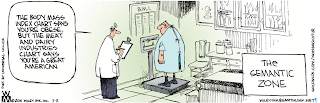


Finally, then, overweight people are made subject to/of these discourses.  They can no longer simply be overweight.  They are now centrally aware of the characteristic that distinguishes them—i. e. the signifying difference that defines them.  They become not just overweight, but the overweight, the obese—the problem of obesity, in short, becomes a locus for the crystallization of a subjective sense:  they are subjects (the obese) because they've been made subjects of/in the discourse of obesity.  Here, by the way, I think that one can see pretty clearly where Foucault differs from Althusser, in ways that make Foucault a much more sophisticated analyst.

But the discourse does not stop here.  As Foucault says elsewhere, discursive practices represent lines of power and the contest between lines of power.  Having made the obese subjects of their own girth, the discourse now empowers them to re-visualize their material circumstances.  Next thing you know, there are overweight activist groups demanding that turnstiles in the New York subway system be made wider.  A radical group in San Francisco blows up a revolving door that was not wide enough to accommodate the obese.  Demands for wider seats on buses, trains, airliners proliferate.  Political Action Committees form and lobby Congress and the President.  Newspaper pundits take sides—George Will, surprisingly, comes in on the side of the obese.  In short, the political system is engaged in the discourse of obesity and soon federal law mandates that vehicles participating in interstate commerce of any sort have wider seats.  Transportation industries grumble at the requirement, and form the Industrial Standards Organization, which finances an ad campaign to encourage self-loathing on the part of the obese.  The Obese Liberation Movement is formed as a response, and takes a case all the way to the Supreme Court, which decides that freedom of speech comes before the emotional tranquility of the obese.  But the political power of the Obese Liberation Movement forces a retooling of all of the factories concerned with seats in transportation.  That entails entirely new industrial models for die and tool manufacturing.  Before long even seating arrangements in private homes begin to change simply because furniture manufacturers use the same tools to build domestic as public seating arrangements.  So all chairs, sofas, benches, etc. are now made wider.  Here again a secondary market in the parts business flourishes.

In academic and artistic discourses the new awareness of obesity engenders a re-view of critical judgments and practices.  A new study of Shakespeare's Henry IV plays argues that the obese Falstaff is the real hero of the sequence.  Post-obese artists refigure the ideals of beauty and soon the new image becomes evident in TV commercials where overweight models are in demand.  The Industry Standards Organization withdraws all of its ads and capitulates entirely to the new requirements inscribed in law and practice.

But, of course, there are discourses that resist the hegemonic power of the discourse of obesity.  The medical community objects against obesity on the essentialist ground that being overweight is bad for health.  A radical wing of the Obese Liberation Front therefore bombs some clinics, and a splinter group of that wing spikes Diet Kool Aid with psychoactive drugs.  But by this point the discourse of obesity has intersected so many other discursive practices—industrial, political, civil libertarian, artistic, etc., etc.—that even the AMA comes to a compromise solution of the problem.  A new ideology of "safe weight" is formulated. Still, in furtive conversations that take place in locker rooms everywhere, "fat jokes" are whispered from skinny person to skinny person.


I stop here simply because by this point I hope that the nature of "discourse" is clear.  I also hope that the reason why one really cannot define the term is clear:  to define it would mean that one gives it a rational formulation—but the characteristic of discourse is that it evades rationality and invades material practice—or, as Foucault says, it works within "systems of dispersion" (Archaeology 37).

Finally let me also point out that a discourse of obesity is not far-fetched.  Whether it achieves the sort of significance that the discourse of sexuality achieves is, of course, much in doubt simply because not everyone is obese, but everyone is sexed.  This suggests that not all discourses engage the same degree of social energy.  So, for instance, the discourse of cellulite, which once was pretty noticeable on TV, seems to have come to naught.  But being overweight may be closely affiliated with the discourse of sexuality itself—the pleasures of eating are, psychoanalytically speaking, akin to the pleasures of sex, as Mr. Palomar discovered when he finds himself in the presence of a pound of goose fat.  If the discourse of obesity is thus associated with the discourse of sexuality, then their coincidences and overlappings may energize the discourse of obesity and make it become culturally significant.  In fact, in the silencing of obesity one might argue that it already is a significant discourse, so that anorexic and bulemic women—and it's not irrelevant to the coincidence of food and sex that for the most part it's a particular sex that suffers from those ailments—are embodying the silence of the discourse.  In any case, the discourse of obesity, like the failed discourse of cellulite or like the very powerful discourse of smoking, is one of the discourses of the self that, Foucault suggests, are made possible in the first place by the discourse of sexuality itself.  All these discourses enable the subject:  without them, one cannot crystallize a self from out of the undifferentiated mass of human possibilities.  Such enabling, Foucault suggests, leads to a rich creativity—the whole industry of wider seats, for instance.  But the self thus made into a subject is also a mere fragment within the continuum of human practices.  In that sense, the crystallization of a self according to discursive practices has the effect of isolating the individual within the limits of the discourse—that is to say, if we mix Althusser and Foucault, of subjecting him to the power of the self-written ideology.  Such paradox, as well as such fragmentation, is the condition of postmodernism.

Note as well that the contestation of the idea of "obesity" makes possible a point of historical inflection, a borderline or liminal moment:  before the contestation we're in one historical period; after the contestation we're in another one.  For Foucault, then, historical periods are really an expression of the way that discourses sort themselves out, not simply a matter of one monarch or president ruling and then being followed by another monarch or president.

Monday, August 12, 2024

Elites

Talking heads and republicans always talk about the elites who support democratic party candidates and policies.  It’s so commonplace that you sort of have to stop and think about the term, “elites,” to see just how strange the word is when applied to democrats.


Is the elitism a matter of money?  There’s no doubt that there are rich people on the democrats’ side of the ledger.  But to suggest that wealth is peculiar to democrats to the exclusion of republicans is . . . so obviously nonsense that it’s not even worth arguing against the idea.  Still, consider which pair of candidates boasts millionaire and billionaire status.  According to a Time Magazine article this past July, just two or three weeks ago, Kamala Harris is worth about eight million bucks.  Her republican counterpart claims that he’s worth some ten billion dollars.  In the VP horse race, the headline to an article in 8 August of this year, in Fortune magazine, says it all:  “Tim Walz’s net worth is less than the average American’s.”  By contrast, according to Forbes as reported in a July article in Time Magazine, J. D. Vance is worth around ten million dollars.  So the top of the democratic ticket is poorer—an odd word in this context!—than the bottom of the republican ticket.


The same economic differences and equivalencies are no doubt spread throughout the wider membership of the two parties.  Nonetheless, there is no doubt at all that the great business magnates are predominantly in favor of republican candidates because they see republican policies as benefitting them and the wealth that they do not want to share with the rest of us via a more equitable tax structure.


So much for economic elitism.


Is the elitism a matter of familial descent, a sort of American version of European aristocracy?  I honestly do not know about the familial history of any republican or democrat.  Sure, we know that the Kennedys are supposed to be American royalty—but the familial influence of the Kennedys begins with the wealth of Joseph Kennedy, who is JFK’s father and RFK Jr.’s grandfather.  That’s not exactly a long-standing aristocratic heritage.  And, in point of fact, it is as “established” as is the pedigree of the Trumps.  Donald’s grandfather, Friedrich Trump, founded the dynasty; Fred Trump, Donald’s father, increased the wealth of the family; Donald himself benefitted from that wealth in the same way that Joseph Kennedy’s kids benefitted from his wealth.  Are there other dynastic families in the two parties’ followers?  Sure.  The Roosevelts—oops, apparently all gone, and in any case evenly divided between republican and democrat; the Bushes; the Rockefellers; anyone else?


So much for “aristocratic” elitism.


Is the elitism a matter of education?  Here there does seem to be a difference that “privileges” followers of the democratic party.  According to the Pew Research folks, in the 2022 election, 49% of democratic voters did not have a college degree, whereas 63% of republican voters did not.  I assume that that difference leads to the differences in the votes among suburbanites, insofar as, again I assume, a college degree makes possible the middleclass status that leads to the ability to move to the ‘burbs.  Again according to Pew, in 2022 the democratic suburban vote was 57%, whereas the republican suburban vote was 53%.  Not a huge difference, to be sure, but large enough to make a difference in electoral outcomes when the margins between winners and losers are as slim as they have been for many years. Whether being able to afford to live in a suburb means that the person is “elite” is a different question, of course.  Is it the case that the American self-identification as a middleclass society is no longer valid?


I’m tempted to say so much for “educational” elitism here, although there is a fillip of support for the notion that democrats have a higher degree of college education than do republicans.


One final question:  is the “elitism” a matter of race?  I want to preface this by saying that to my mind there is nothing “elite” about any racial category, except insofar as some of those categories have institutional and historic privileges that matter a great deal.  In that contex, and with that limitation, then, Pew indicates in 2022 non-Hispanic whites represented 85% of the republican electorate and 64% of the democratic electorate.  That means that “minorities” voted for republicans at the rate of 15%, whereas for democrats at the rate of 36%.


So finally we have a clear “elite” advantage for democrats, in the rate of minority participation.